Hybrid
becomes Hyundai Motor's new U.S. strategy
By Lee Min-hyung, The Korea Times - Hyundai
Motor is expanding hybrid production and local sourcing in the United States,
in a strategic shift to blunt the impact of tariffs.
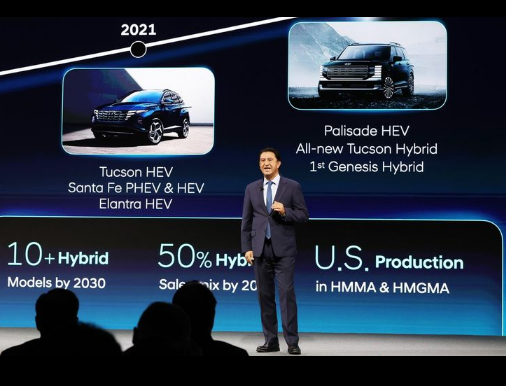
The effort — unveiled at its 2026 CEO
Investor Day on Wednesday — is centered on its plan to offer more than 10
hybrid models in North America by 2030, with a goal of making hybrids account
for around half of its regional sales there.
The strategy goes beyond expanding its
hybrid lineup. Hyundai said it will raise its North American local parts
sourcing target to 80 percent in the same timeline, up from the previous target
of 60 percent, as it seeks to build a more localized supply chain and reduce
exposure to trade-related costs.
The vehicles will be produced at Hyundai
Motor Manufacturing Alabama and Hyundai Motor Group Metaplant America in
Georgia.
The shift comes as Hyundai Motor faces a
more uncertain U.S. auto market. The company is subject to a 15 percent tariff
on automobiles, while uncertainty over future U.S. trade policy continues to
weigh on the automaker's long-term investment decisions.
To mitigate the risks, the carmaker is
increasingly turning to hybrids as a way to maintain sales and profitability at
a time when the U.S. auto industry’s transition to fully electric vehicles
(EVs) remains uneven.
The approach is already showing results.
Hyundai Motor's U.S. hybrid sales jumped 71 percent in the second quarter from
a year earlier. North American sales reached 595,457 vehicles in the first half
of this year, marking the company's best first-half performance in the region.
Combined U.S. sales of Hyundai Motor and Genesis rose 3 percent to 489,656
vehicles during the same period.
Hyundai's hybrid push is also closely
tied to its effort to improve profitability. The company raised its 2030
operating profit margin target to more than 9 percent, citing the expansion of
hybrid models across compact, large and premium segments, as well as
cost-cutting measures.
At the same time, Hyundai is preparing a
third option between conventional hybrids and EVs. It plans to launch its first
extended-range electric vehicle, or EREV, in the first half of 2027. The Santa
Fe EREV, set to be built in Alabama, is expected to offer more than 900
kilometers of total range while retaining an electric driving experience.
The strategy reflects a recalibration of
Hyundai's U.S. electrification road map. Rather than betting on a single
powertrain, the company is expanding hybrids and EREVs while continuing to
invest in EVs and their local production.
That could allow the automaker to turn a
period of tariff pressure and uncertainty into an opportunity to deepen its
manufacturing footprint in the world's second-largest auto market.
“The move is seen as the carmaker’s
strategic shift toward a more localized U.S. business model in which
production, sourcing and powertrain choices are increasingly designed around
American market conditions,” an official from the auto industry said.
Source: https://www.koreatimes.co.kr/business/companies/20260827/hybrid-becomes-hyundai-motors-new-us-strategy