SK
hynix, Sandisk unveil standards for high-bandwidth flash memory
By Nam Hyun-woo, The Korea Times - SK
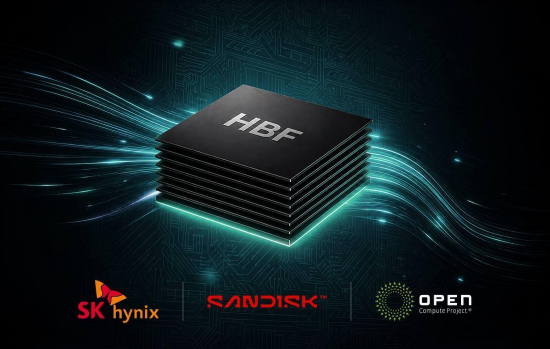
hynix and Sandisk have introduced the industry's first standards for
high-bandwidth flash (HBF), a storage technology designed to accelerate
artificial intelligence (AI) inference by enabling faster data transfers,
similar to the role high-bandwidth memory (HBM) plays in AI systems.
According to SK hynix, the two companies
will unveil the standards at the Future of Memory and Storage 2026 exhibition,
held in California from Tuesday through Thursday (local time). Through keynote
speeches and panel discussions, they will present HBF as a key technology for
addressing memory bottlenecks in the AI era.
In AI accelerators, HBF is designed to
sit between HBM and storage devices such as solid-state drives (SSDs). It
offers significantly higher bandwidth than SSDs while retaining the large
storage capacity of NAND flash memory.
As AI inference drives explosive growth
in the amount of data processing, HBF is drawing attention as a technology
capable of delivering both high bandwidth and scalable storage capacity.
The new standards came six months after
SK hynix formed a consortium with Sandisk. They defined two configurations of
stacking eight or 16 NAND dies, supporting capacities of up to 512 gigabytes
(GB). The standards also classified bandwidth into three grades, ranging from
about 0.4 terabytes per second (Tbps) to 3.0 Tbps.
SK hynix stressed that HBF and logic
processors will be connected through Universal Chiplet Interconnect Express
(UCIe), an open standard for high-speed chiplet interconnects, allowing HBF to
be more flexibly integrated with central processing units (CPUs), graphics
processing units (GPUs) and other logic processors.
The standards also cover interface and
electrical specifications, reliability and packaging guidelines for HBF die
stacks, and software guidelines for data input and output.
In the semiconductor industry,
publishing technical standards is generally seen as a first step toward
building an ecosystem around a new technology, allowing multiple companies to
develop compatible products under a common specification.
SK hynix said it will leverage the
standard publication as an opportunity to expand the adoption of HBF technology
in the AI storage market and foster the surrounding ecosystem. With Google and
Tenstorrent currently participating in the HBF consortium, the consortium will
expand its reach while enhancing technical maturity and market acceptance based
on open collaboration.
On the first day of the event, SK hynix
Executive Vice President Kim Chun-sung and Vice President Kang Uk-song will
deliver a joint keynote address on improving AI infrastructure efficiency
through tiered memory architecture. On Thursday, SK hynix Vice President Lim
Eui-cheol, Sandisk Vice President Rajeev Nagabhirava and Google DeepMind Senior
Staff Engineer Xiaoyu Ma will join a panel discussion titled “Breaking the
Memory Wall with HBF.”
Throughout the event, SK hynix will
operate a booth to showcase its new technologies including its 10th-generation
375-layer 4D NAND wafer and products.
“With the rapid spread of AI
applications, we are at a point where overall data processing structures must
be redesigned,” Kim said.
“Through HBF, SK hynix will expand the
boundaries between memory and storage and contribute to building new
architectures that enhance overall system efficiency.”
Source: https://www.koreatimes.co.kr/business/tech-science/20260804/sk-hynix-sandisk-unveil-standards-for-high-bandwidth-flash-memory