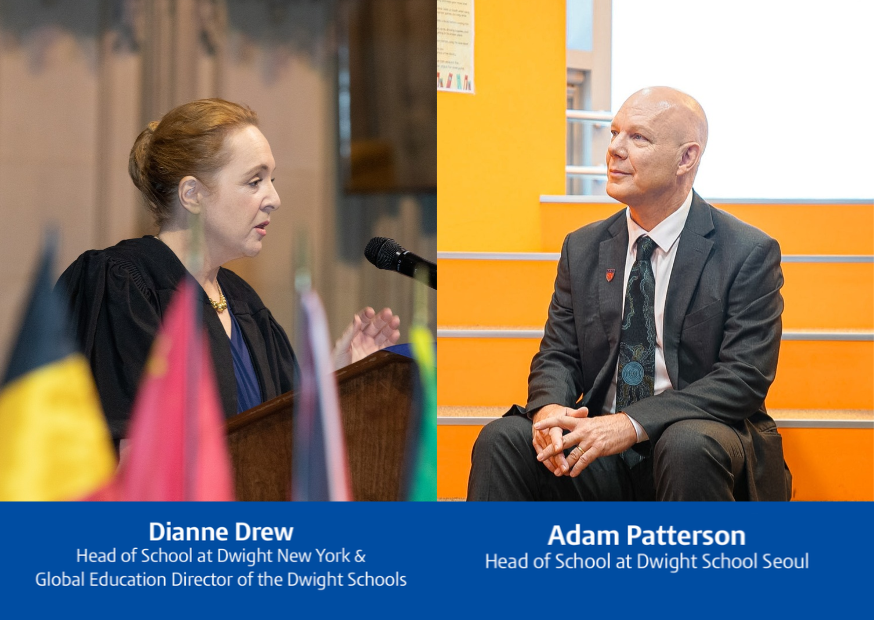
The global network of Dwight Schools now spans major cities across North
America, Europe, Asia and the Middle East. In an increasingly interconnected
world, what does it mean to provide a truly “global education” today, beyond
simply having an international student body?
DD: For me, a truly global education goes far beyond an international mix of passports in the
classroom. It means students moving fluidly between perspectives, encountering the same
big questions through different cultural lenses, and understanding that there is more than
one valid way to approach a problem. Across our ten campuses, we work deliberately to
connect classrooms so that a project in New York can draw on the experience of peers in
Seoul, London, or Dubai. Global education today is about building that muscle: the ability
to collaborate across differences, hold multiple perspectives at once, and see one’s own
context as part of something larger. It is less about where a student's classmates come
from, and more about how wide a world they learn to think in.
AP: Beyond the strengths of Dwight School Seoul itself, one of the things that drew me to the
position was the opportunity offered by the wider global network of Dwight Schools. A global
education is not created simply by having students from different countries or schools in
different cities. Those connections need to be experienced through shared learning, staff
collaboration and genuine relationships across the network. Being part of something bigger
than one school helps students recognize that their own viewpoint matters, but that it is
not the only one. Learning to listen to others, question their assumptions and contribute
confidently within a wider community is what being globally minded means to me.
Dianne, as Global Education Director, you oversee academic collaboration
across the global network of Dwight Schools. How do you maintain a shared
educational philosophy across schools in very different cultural and educational
environments while still allowing each campus to develop its own identity?
DD: We hold the network together through a
shared philosophy rather than a shared
script. Every Dwight School is anchored in
the same core commitments – personalized
learning built around each student's Spark
of Genius, a strong sense of community,
and a genuine global vision – but how those
commitments show up in Seoul, London or
New York is shaped by the culture, families
and educators on the ground. I think of it
less like a chain of identical stores and more
like a constellation: each campus is a distinct
point of light, but all part of the same pattern.
Regular collaboration between school leaders
keeps that philosophy alive and consistent,
while giving each Head of School real latitude
to build an identity that fits their own
community.
What are some of the most meaningful ways students and educators benefit
from being part of the global network of Dwight Schools? How have you seen
cross-campus collaboration influence learning, teaching, or the way students
understand the world?
DD: The clearest benefit is exposure to a genuinely wider set of ideas. When teachers from
different campuses compare notes on curriculum, assessment or student support, they
are pressure-testing their own practice against very different contexts, and that makes
everyone sharper.
For students, that same connection takes very concrete forms: cross-campus exchange
opportunities that enable a student to spend real time learning at another Dwight School;
experiential trips that take a class beyond their own campus, and often their own country;
global competitions where students test what they have built or written against peers from
Dubai to Shanghai; and events like our Dwight International music festival, which brings
performers from across all ten campuses together on one stage. Those are not abstract
ideas about “the world” – they are real relationships with real peers, built through shared
experiences. I have seen students become noticeably more confident and more curious
once they have had that kind of opportunity. It reframes the rest of their education: they
start thinking about the world beyond their home and how things are done elsewhere.
Adam, you recently joined Dwight School Seoul (the first IB Continuum school
in Seoul) after more than three decades in international education. What
attracted you to both Dwight and Korea, and what were your first impressions
of the school and its community?
AP: A parent recently asked me how I was settling in, and my immediate response was that I
felt as though I had always been here. For me, that says a great deal about Dwight School
Seoul. The strength of its community is not simply something written in the school’s
values. I have experienced it in the welcome from students, staff and families, and in the
commitment to ensuring every student is known, supported and challenged.
After more than three decades in international education, I was drawn to Dwight by its
commitment to personalized learning and the opportunities created through its wider global network. Korea was equally compelling. It is a country with a rich culture, a strong
commitment to education and an extraordinary global influence in technology, business
and innovation. The opportunity to lead an established international school in such a
dynamic environment, while connecting our community with something larger, made the
role particularly exciting.
As you begin your tenure as Head of School, what are your priorities for
Dwight School Seoul, and how do you hope to build upon the school's existing
strengths while bringing your own perspective and experience to the role?
AP: I do not see my first year as
arriving with a list of things
to fix. Dwight School Seoul is
already a strong school with
an exceptional community
and a clear commitment
to personalized learning.
Students are known as
individuals and have the
confidence to be who they
are. My role is to protect and
build upon those strengths.
Like every strong school, we will continue to strengthen teaching and learning, while
creating greater opportunities for students and staff through the global network of Dwight
Schools and investing in professional development and support.
Having worked across different cultures and educational settings, I bring a broad
perspective on what helps schools succeed. Clear structures, thoughtful processes and
strong organization matter, but they must always support people and learning. I also
believe in being visible and accessible, listening carefully to the community and working
with students, staff and families to shape the school’s next stage.
Global networks are often discussed in terms of what an individual campus
gains from being part of them. Looking in the other direction, what
perspectives, strengths, or innovations does Dwight School Seoul bring to the
wider Dwight community?
DD: Dwight School Seoul brings a market that is intensely focused on academic excellence
and deeply invested in education as a family priority – that raises the bar for all of us.
It also brings a genuinely innovative, technology-forward culture; Korea’s strength in
that space pushes us to think harder about how our schools prepare students for a fast
changing economy. And Adam brings decades of international leadership experience that
strengthens the thinking of our whole network.
Every campus that joins our family of schools adds its own expertise to a shared pool,
and Seoul’s contribution – in academic rigor, in its relationship with technology, and now
in Adam’s leadership – is already shaping conversations well beyond Korea. I also see
this firsthand in our students: our own community is genuinely invested in South Korea
itself – curious about its culture, its language, and its place in the world, not just its school
system. The creative energy South Korea is known for globally – in music, film, design and
technology – is a real source of excitement across our other campuses. Students elsewhere
in the network follow K-pop, Korean film and Korean design with real enthusiasm, and that
gives Dwight School Seoul a kind of cultural gravity: it is not just contributing academically,
it is a campus that other students actively want to connect with and learn from.
AP: I am still relatively new to Dwight School Seoul, so part of my responsibility is to listen and
understand fully what the school can contribute. However, one of the reasons I accepted
the position was the opportunity not only to benefit from a global family of schools, but
also to give something back to it.
I have already found a school with talented educators, a strong commitment to
personalized learning and considerable experience across the IB continuum. Dwight School
Seoul can bring that educational expertise together with the perspectives that come from
living and learning in one of the world’s most technologically advanced and culturally
influential countries. Our contribution should be active: sharing effective practice, initiating
projects across campuses and ensuring that the ideas and voices of our students and staff
add real value to the wider Dwight community.
Dwight’s educational philosophy centers on identifying and nurturing the
“spark of genius” in every child. How is this philosophy translated into
personalized learning across the global network, and how does it take shape
at Dwight School Seoul?
DD: We describe it exactly as our Spark of Genius framework lays it out: every student who
walks through a Dwight door carries something unrepeatable – a particular combination
of curiosity, talent and way of seeing the world that is theirs alone – and our job is to find
that spark and give it room to grow, not to install knowledge in a standard shape. It isn’t a
fourth pillar sitting alongside Personalized Learning, Community and Global Vision; it’s the
reason those three exist.
Personalized Learning is how we notice a child’s spark. Community is the environment
where they feel safe enough to show it. Global Vision is where we send it once it’s strong
enough to travel. In practice, that starts with a simple discipline: we begin by asking who
this particular student is, what they are curious about, and where their strengths lie, and
we build their learning experience around that. Across the network, this shows up as
flexibility in how students are assessed, choice in what they pursue, and a genuine effort
by teachers to know each child well – and it is quite literally what our global network is
for, proving that a child’s spark isn’t bound to one building or one culture, through cross
campus collaboration and shared curriculum innovation.
At Dwight School Seoul, that same philosophy is expressed through a rigorous academic
core, reflecting the strong value families here place on achievement combined with real
room for students to pursue the individual interests and strengths that the core alone
might not reveal. The framework doesn’t change from campus to campus; what changes
is how each school notices and nurtures the sparks in its students and teachers.
AP: I agree that the Spark of Genius is not a fourth pillar. It is what brings personalized
learning, community and global vision together. For me, it starts with knowing students
well. Personalized learning does not mean creating a separate curriculum for every child.
It means understanding their strengths, interests and needs, then providing the right
challenge, support and opportunities for them to grow.
Our VEX robotics team is a strong example. What began with student interest and
ownership developed through months of designing, testing, failing, rebuilding and
improving. Students brought different strengths to the team, organized themselves,
solved problems together and
ultimately became national
champions. That success was
important, but so was the
learning behind it: resilience,
collaboration, leadership and
the confidence to take their
ideas further. This is the Spark
of Genius in action. A student’s
interest is recognized, the community helps it grow and the wider world provides a place
for it to be tested and shared.
AI and emerging technologies are rapidly changing both education and the
workplace. What skills do you believe today's students will need most to
thrive in the AI era, and how should schools evolve accordingly?
AP: For me, the key question is not whether students should use AI, because it will be part of
their lives and work. The real question is whether they can make good decisions about
how and when to use it. Students need the knowledge and judgement to question what
AI produces, recognize when something does not seem right and know when their own
thinking must lead. Schools must therefore make thinking more visible and place greater
value on curiosity, creativity, empathy and collaboration. We should prepare students to
use AI confidently, but also to bring the human qualities that technology cannot replace.
DD: Across the network, we have tried to turn that philosophy into practice through our
Artificial Intelligence, Agentic AI, and Responsible Innovation Policy and an AI Assignment
Levels framework that runs from fully independent work through fully AI-assisted work,
with teachers specifying which level applies to a given task and students expected to
be transparent about how they used AI. That structure does two things: it protects the
development of foundational skills where they still matter, and it gives students explicit
practice in the judgment Adam is describing – deciding when AI is the right tool and when
their own thinking has to lead. The skills we are prioritizing alongside that – curiosity,
creativity, empathy, collaboration – are not a reaction to AI so much as the capabilities that
become more valuable, not less, as more routine tasks are automated.
Interest in the International Baccalaureate (IB) has been growing in Korea in
recent years. From your perspective, what does the IB approach offer students
in Korea, particularly as education increasingly emphasizes critical thinking,
creativity, and adaptability alongside academic achievement?
AP: What I value most about the IB is
that it asks students to do more
than remember knowledge. They
must question it, connect it and
use it. Academic achievement
remains important, but students also
need to communicate well, think
independently and adapt when the
answer is not obvious. The IB develops
these transferable skills within an
international context, helping students
understand different perspectives and
move confidently between countries,
cultures and future opportunities.
Drawing on your experience across different education systems, what have
you observed about the expectations and priorities of families in Korea? How
is Dwight School Seoul responding to those expectations while maintaining
its international educational philosophy?
AP: Across different education systems, I have found that families share the same fundamental
hopes: they want their children to do well, be happy and have meaningful opportunities
after school. In Korea, there is a particularly strong commitment to education and high
expectations for academic achievement.
At Dwight School Seoul, we see families as important partners in achieving those
goals. Our responsibility is to ensure students develop strong knowledge and achieve
academically, while also building the confidence, skills and personal attributes they will
need beyond school. This is central to our international philosophy: preparing young
people not only for their next stage of education, but to contribute and thrive in an
interconnected world.
As companies and talent become increasingly mobile, access to high-quality
international education can play an important role in a city's attractiveness to
global families. What role do you believe schools like Dwight can play in
strengthening Seoul's position as a destination for international talent?
AP: For global families, confidence in their children’s education is central to any decision to
relocate. Schools like Dwight strengthen Seoul’s attractiveness by providing a high-quality
international education that develops transferable skills and allows students to move
successfully between countries and education systems.
Equally important is belonging. An inclusive school with an exceptional community can
provide a home away from home, helping students and families settle, build relationships
and feel connected to life in Seoul. When families know their children will be supported,
challenged and welcomed, Seoul becomes not only a place to work, but a place where
they can build a life.
DD: I would add that this works in both directions. A city’s appeal to global talent is not only
about the schools that exist there – a strong international school network also gives a city
credibility with the companies deciding where to send their people. When multinational
employers know that Dwight, or schools like it, can provide consistent, high-quality
education across the cities where their employees might be posted, that reduces the risk
in an international assignment and makes Seoul a more competitive option, not just a
viable one. It is a genuine partnership between international education and the mobility
of global talent.
How can international schools and the global business community work
together to prepare students for the future? Where do you see the greatest
opportunities for meaningful collaboration between schools and businesses?
AP: International schools and the business community are already closely connected. Many of
our families bring valuable professional experience and global perspectives to our school
community. The opportunity is to draw on these connections more deliberately through
mentoring, workplace visits, internships and real-world projects.
For Dwight School Seoul, Korea’s strength in technology, innovation and global enterprise
creates exciting possibilities. By working with AMCHAM members and our parent
community, we can connect learning with authentic challenges and help students see
themselves not simply as preparing for the future, but as having a role in shaping it.
DD: From the network side, one of the most valuable things AMCHAM member companies
can offer is not funding but access to real projects, real mentors and real problems.
Some of the strongest learning experiences we see across our campuses come from
partnerships where students are working on something a business genuinely needs
solved, not a simulation of one. I would also point to the reverse opportunity: businesses
gain early insight into how the next generation thinks and works, which is valuable in its
own right. The more we can formalize those exchanges – through structured mentoring
programs or recurring project partnerships rather than one-off visits – the more durable
the collaboration becomes.
Looking ahead, what is your shared vision for Dwight School Seoul's role
within the global Dwight community? What would you most like students and
families in Korea to gain from that connection?
AP: My vision is for Dwight School Seoul to play an active and influential role within the global
Dwight community. We live in a connected world, and our students should experience
the value of that connection through meaningful collaboration, different perspectives and
opportunities beyond their immediate environment.
Dwight School Seoul also brings the perspective of Korea, a vibrant, technologically
advanced country with a rich culture and a strong spirit of innovation. We have excellent
practice to share, while also much to gain from working with other Dwight schools.
For students and families in Korea, I want that connection to be visible through shared
learning, relationships and opportunities that can realistically be developed across the
network.
DD: I share that vision, and from the network’s side, I want Dwight School Seoul’s voice to carry
real weight in it. We are intentional about not treating any campus as a satellite of another – the strongest ideas in our network have come from schools finding their own answers to
shared challenges, and Seoul is already positioned to be one of those sources. For families
in Korea, I hope the tangible result is a wider horizon for their children: relationships with
peers in other countries, teachers drawing on ideas tested elsewhere in the network, and
over time, Dwight School Seoul’s own practice being adopted by other campuses. That
reciprocity, more than any single program, is what a global network is for.
Read the full article in the 4Q Journal.