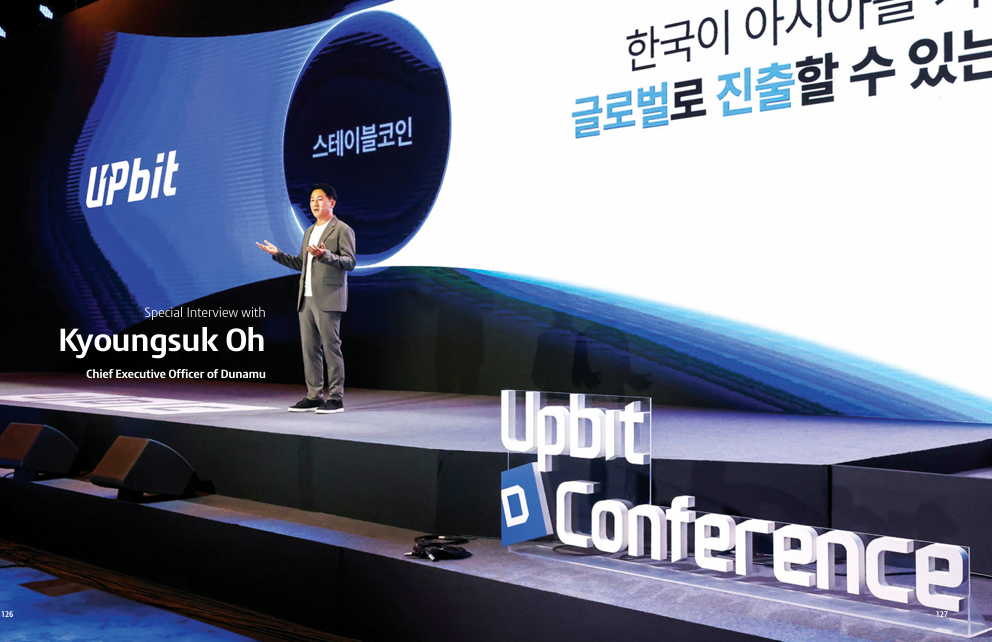
Special Interview with Kyoungsuk Oh, CEO of Dunamu
(Featured in 2026 4Q AMCHAM Journal)
Can you tell us about your career journey and what led you to Dunamu? How
have your experiences influenced your leadership approach?
My career has taken me through finance, law, the judiciary and corporate management, and
each of those experiences has shaped how I think about leadership today.
I began my career as a certified public accountant at Samil PwC, where I learned to look at
businesses through the lens of financial discipline and fundamentals. I moved into law, practicing
at Kim & Chang, and served as a judge and as a Judicial Research Officer at the Supreme Court of
Korea. Those experiences taught me the importance of governance, accountability and making
decisions based on clear principles and evidence.
I spent seven years as CEO of Panco, a Korean apparel manufacturer. That moved me from
advising and evaluating businesses to actually running one. It taught me that leadership is
ultimately about execution: setting priorities,
making decisions under uncertainty, building
organizations that can adapt, and taking
responsibility for outcomes.
When I joined Dunamu as CEO in 2025, I saw
a company at an important inflection point.
Upbit had already established a strong position
in Korea and significant scale globally, but
digital assets themselves were also entering
a new phase – moving beyond trading
toward payments, tokenization, blockchain
infrastructure, AI and deeper integration with
the broader financial system.
That combination was compelling to me.
Dunamu had the technology, user base and
operating experience to play a meaningful
role in that transition, but doing so responsibly
requires strong governance, compliance and
operational discipline.
My leadership approach reflects that background. I tend to think about innovation and stability
together, rather than as competing priorities. In a fast-moving industry, you need the ambition
to move quickly, but also the discipline to build systems that can earn trust over time. I believe
sustainable growth in digital finance will come from companies that can do both.
Dunamu has evolved significantly since its founding, from fintech services to
becoming one of Korea’s leading digital asset companies. How would you
describe Dunamu’s vision today, and how has that vision evolved as digital
assets have become increasingly integrated with the broader financial system?
Dunamu’s overarching
vision remains focused
on creating new value
by connecting diverse
financial participants
through technology that
earns client trust and
benefits society.
Upbit remains at the
core of our business,
and operating a secure
and reliable market will always be fundamental. But the boundaries between digital assets and traditional finance are
becoming less distinct. We are seeing tokenization, stablecoins, blockchain-based settlement and
AI reshape how financial products are created, distributed and used.
Our ambition today goes beyond operating a digital asset exchange. We want Dunamu to
become a trusted infrastructure company for the next generation of digital finance.
A landmark step in this journey was our strategic announcement of a planned comprehensive
stock swap and alliance with Naver Financial. While this proposed merger is currently undergoing
regulatory review and approval, the shared vision brings together Naver’s vast AI and payment ecosystem with Dunamu’s Web3 infrastructure. Today, we are focused on deploying beneficial
technologies that combine artificial intelligence, Layer 2 blockchain networks, and regulated
payment rails to advance Korea’s position in the global digital economy.
Stablecoins have emerged as one of the most closely watched areas of digital
finance globally. How does Dunamu view the role of stablecoins, and where do
you see the greatest potential for them to create practical value for consumers
and businesses?
Blockchain is widely recognized as the future of finance, yet for many years it remained
disconnected from the traditional financial system. The vital bridge connecting these two
worlds is the stablecoin. With the global stablecoin market cap reaching around $300 billion,
stablecoins are no longer just a payment instrument – they are actively transforming the very
infrastructure of global finance. As stablecoins become more mainstream, they naturally
carry forward the underlying blockchain infrastructure, including chains, digital wallets, and
decentralized applications.
This shift extends far beyond simple transfers, rapidly reshaping lending, asset management,
and capital markets into Web3-based services, while extending financial inclusion to the people
worldwide who remain outside the formal banking system. Crucially, current market data
reveals that exchange-backed stablecoins account for the overwhelming majority of total market
cap, whereas fintech-issued stablecoins remain on a much smaller scale. This underscores the
central, indispensable role that exchanges play in driving mainstream adoption.
Just like the early days of the internet, blockchain and stablecoin adoption is still in its infancy,
and the growth potential is immense. Where global big tech companies led the internet and AI
revolutions, the blockchain revolution gives Korea and Dunamu a historic opportunity to build
a new financial order with global partners. A prime example of our strategy in action is our
August 2026 strategic partnership with Visa, signed in San Francisco, where we are exploring
24/7 cross-border remittances, real-time merchant settlements, and open-standard models like
Open USD (OUSD). Coupled with our proposed synergy with NAVER Financial, and our GIWA
Layer 2 chain, we are helping lead this global transformation toward a fully connected Web3
financial ecosystem.
The convergence of AI and digital finance is also accelerating. How does
Dunamu envision AI changing the way people interact with financial services
and digital assets?
At Dunamu, we see AI as having two important roles: improving the user experience and
strengthening the reliability of the underlying financial infrastructure.
On the consumer side, we are exploring how AI could make services more intuitive and
automated. Through strategic collaboration with global leaders, we are looking at the potential
of agentic commerce, where AI agents could operate within clearly defined permissions to
perform tasks such as making payments. Also exploring managing cross-border transactions, or
helping users manage their assets based on parameters they have set.
AI is also increasingly important to how we operate our exchange (Upbit). We’ve deployed
Machine-learning to help analyze large volumes of network, transaction and trading data in real
time, helping us detect anomalies, strengthen transaction monitoring and improve operational
resilience.
In financial services, however, greater automation must come with greater accountability. We
believe AI should make finance simpler and more efficient without compromising security,
transparency or user control. Ultimately, the most valuable role of AI will be to reduce complexity
while keeping people firmly in control of their financial decisions.
What role do you envision GIWA playing in the broader digital finance
ecosystem, and what needs to happen for blockchain infrastructure to achieve
mainstream adoption?
With GIWA, our Ethereum Layer 2 blockchain built on Optimism’s OP Stack, we are extending
Dunamu’s capabilities beyond exchange operations into open, high-performance Web3
infrastructure.
GIWA is designed for fast and cost-efficient transactions, and more importantly, we are trying to
address one of the fundamental challenges facing financial institutions as they move on-chain:
how to combine the openness and liquidity of public blockchains with the trust and privacy
requirements of financial services.
Traditional financial institutions have often turned to private blockchains to address those
concerns. But as more participants and services are added, closed networks can become
increasingly complex to connect, while liquidity can remain fragmented within individual systems.
Our approach with GIWA is to preserve the openness of a public blockchain while adding layers
that can support institutional use cases.
That includes Dojang, an on-chain attestation service designed to add verifiable trust, and Bojagi,
a privacy protocol that allows sensitive information to be protected when necessary without
giving up the benefits of an open network. Together, these capabilities are intended to provide
a foundation for applications ranging from stablecoins and decentralized applications to Web3
based financial and capital-market services.
For blockchain to achieve mainstream adoption, however, the technology itself also needs to
become much less visible to users. Gas fees, private-key management and network selection remain
significant sources of friction. That is why we are developing Giwa Wallet – to make interacting with
decentralized networks feel as intuitive and familiar as using a mobile banking application.
132
Ultimately, blockchain will become mainstream when users and businesses can benefit from its
capabilities without needing to understand the technology underneath. We see GIWA’s role as
providing an open, trusted and accessible foundation on which the next generation of digital
financial services can be built.
Ultimately, blockchain will become mainstream when users and businesses can benefit from its
capabilities without needing to understand the technology underneath. We see GIWA’s role as
providing an open, trusted and accessible foundation on which the next generation of digital
financial services can be built.
What regulatory developments do you believe will be most important for
Korea to develop a globally competitive digital asset ecosystem while
maintaining strong consumer protections?
Korea has taken a step-by-step approach to digital asset regulation, and I think that has created
an important foundation for the market.
The Act on Reporting and Using Specified Financial Transaction Information established
Korea’s framework for virtual asset service provider registration and anti-money laundering
requirements, and recent revisions have further strengthened entry requirements, including
scrutiny of major shareholders, controlling shareholders and executive qualifications. The
Virtual Asset User Protection Act built on that foundation by establishing clearer standards
around customer asset protection and market integrity. Together, these measures have helped
strengthen trust and credibility in Korea’s digital asset ecosystem.
The next stage is to build on that foundation while creating clearer pathways for the market
to develop further. I believe several areas will be particularly important: establishing well
defined frameworks for institutional participation, providing regulatory clarity around stablecoin
issuance and real-world asset tokenization, and continuing to strengthen standards for custody,
disclosure, cybersecurity and anti-money laundering.
Global compatibility will also matter increasingly. Digital finance is inherently cross-border,
and Korean companies will need to operate within a regulatory environment that can connect
smoothly with major international markets.
At the same time, we should not overlook how much Korea has already achieved. Korea is one
of the world’s most digitally connected economies, with consumers who are quick to adopt
new technologies and highly engaged in financial markets. That combination has helped create
one of the world’s most active and sophisticated digital asset markets, even before institutional
participation has fully developed. What is particularly encouraging is the depth of the consumer
base. Digital assets in Korea are not a niche product used by a small group of early adopters;
they have become a meaningful part of the broader financial landscape. That gives Korea a
strong foundation as digital finance expands into areas such as stablecoins, wallets, tokenization
and on-chain financial services.
Upbit’s development reflects that broader potential. Since launching in 2017, we have grown
to serve more than 13 million users and account for roughly 70% of domestic digital asset
trading volume. Building that position within a single regulated market has required more than
scale. It has required earning and maintaining user trust through reliable operations, clear
communication, strong safeguards and continuous investment in security and market integrity.
One of our goals is to help demonstrate that Korea should be recognized internationally not
only as an active digital asset market, but as an increasingly mature and responsible one.
Korea does not need to replicate another country’s framework. Its strength lies in combining
strong consumer protections and market integrity with a highly digital, technologically
sophisticated market. If future regulation can preserve that trust while providing greater
predictability for responsible innovation, Korea will be well positioned to become a globally
competitive center for digital finance.
As digital assets become more mainstream, trust, security, and transparency
will become increasingly important. How is Dunamu working to strengthen
trust and consumer protection as the market evolves?
Trust is ultimately the bedrock of financial infrastructure. In digital assets,
that trust has to be earned every day through security, transparency and
reliable operations.
At Dunamu, we approach consumer protection as something that has to
be built into the technology and operating model from the beginning. We
continue to invest in wallet security, cybersecurity, transaction monitoring,
fraud prevention and systems that can identify abnormal activity in real
time. We also believe clear communication with users is critical, particularly
as digital assets become more complex and increasingly connected with
traditional financial services.
As the market evolves, our responsibility also extends beyond protecting
assets on an exchange. The same technology and controls we have
developed through Upbit can increasingly support broader financial and
public infrastructure. Our recent selection to provide custody services
for digital assets seized by Korea’s National Police Agency is one example.
It requires highly controlled custody infrastructure, including isolated
cold-wallet environments and multiple layers of key management and
security.
To me, that is an important sign of how the industry is evolving.
Digital asset companies are increasingly being asked not only to
provide access to markets, but also to demonstrate that their
technology can meet the standards expected of critical financial
infrastructure.
Our view is simple: mainstream adoption cannot come first
and trust second. Trust has to be built into the infrastructure
from the beginning.
Dunamu has been expanding its engagement beyond Korea. What role do
international markets play in Dunamu’s long-term strategy, and where do you
see the greatest opportunities for Korean digital-finance companies globally?
International markets are very important to Dunamu’s long-term strategy, but we do not view
globalization simply as taking a successful Korean business model and replicating it elsewhere.
Financial markets are inherently local. Each country has its own regulatory framework, institutions,
infrastructure and consumer behavior. So our approach is increasingly partnership-driven: working
with strong local and global institutions and combining their market expertise with the technology,
security and operational capabilities we have developed in Korea.
Building on that foundation, the Upbit brand already has a meaningful presence across the APAC
region. Upbit-branded platforms operate in Singapore, Indonesia and Thailand through locally
licensed entities, with fiat trading supported through local financial infrastructure. That provides
a strong example of how digital asset services can be localized to different regulatory and banking
environments while maintaining high standards of compliance and user experience.
We have also focused on building the compliance infrastructure needed for a truly cross-border
digital asset ecosystem. VerifyVASP, a global Travel Rule solution that originated within the broader
Dunamu ecosystem, now connects more than 150 VASPs across more than 30 jurisdictions. I believe
infrastructure like this is just as important to global expansion as the consumer-facing products
themselves. Digital assets move across borders by nature, so compliance, identity verification and
secure information-sharing need to work across borders as well.
Our cooperation with Indonesia’s ICEx reflects the same philosophy. Rather than simply entering
the market as an exchange operator, we are sharing technology and operational expertise to
support the development of a regulated local digital asset ecosystem. Our partnership with Visa
represents another model – connecting Dunamu’s digital asset capabilities with a global payments
network to explore stablecoin payments, cross-border transfers and AI-enabled financial services.
I believe this is where Korean digital-finance companies have a meaningful opportunity globally.
Korea is a highly demanding market. Companies here have had to operate at significant scale while
meeting high expectations for speed, security, compliance and user experience. Those capabilities
can travel.
The opportunity therefore goes well beyond exchange operations. We see significant potential in
blockchain infrastructure, compliance, custody, stablecoins, payments, tokenization and AI-enabled
financial services.
Our objective is not simply to export Upbit. It is to bring the technology, operational expertise and
infrastructure developed through the Korean market into partnerships that can strengthen digital
finance ecosystems around the world.
Where do you see the greatest opportunities for cooperation between the U.S.
and Korea in shaping the next generation of digital finance and innovation?
I think the biggest opportunity goes beyond learning from each other’s regulatory approaches. It
is about connecting two highly complementary financial and technology ecosystems and building
infrastructure that can work across both markets.
The United States brings the depth of its capital markets, the global role of the dollar, major
financial and payment networks, and a powerful technology ecosystem. Korea brings very high
digital adoption and extensive experience operating digital asset services at scale. Put those
strengths together, and I believe there is an opportunity to develop financial infrastructure that is
not only innovative in one market, but designed from the outset to operate globally.
Stablecoins and cross-border payments are one of the clearest examples. As regulated stablecoins
become more integrated with traditional payment networks, the real opportunity is to make
moving value across borders faster, more transparent and more efficient. That will require more
than technology. It will require interoperability across payment networks, blockchain infrastructure,
financial institutions and regulatory frameworks, with strong standards around reserves,
redemption, identity and anti-money laundering.
Tokenization is another important area. The U.S. brings the scale and sophistication of its capital
markets, while Korea is moving toward broader tokenization of securities and on-chain financial
infrastructure. There is significant potential for the two markets to collaborate on the standards
that will make tokenized assets genuinely useful at an institutional level—custody, settlement,
disclosures, data verification and interoperability between traditional and blockchain-based
systems.
And increasingly, AI will become part of that equation. As finance moves toward agentic commerce,
we will need trusted infrastructure that allows AI agents to interact with wallets, payment systems and
digital assets across borders while keeping authorization, security and accountability firmly in place.
For Dunamu, these are not
abstract areas of interest. Our
partnership with Visa is already
exploring stablecoin-based
payments, cross-border transfers
and AI-enabled financial services
by connecting our digital asset
capabilities with a global U.S.
based payment network.
Ultimately, I believe the U.S.-Korea opportunity is to help build the connective tissue of the next
generation of finance. Digital finance will be global by design. The companies and markets that can
make different financial systems, technologies and regulatory environments work together securely
will play an important role in shaping what comes next.
Can you tell us about your proudest moment since taking your current
position?
My proudest moments come from representing Dunamu as CEO during this historic period
when digital assets and traditional finance are converging and a new financial order is
beginning to take shape.
That also comes with a strong sense of responsibility. Dunamu has grown from a Korean
digital asset startup into a company that is increasingly part of global conversations around the
future of finance and blockchain infrastructure. Having the opportunity to contribute to that
transformation – not only for Dunamu, but also for Korea’s role in the future of finance – is
something I am deeply grateful for.
There are moments when this becomes especially tangible. When I meet with leading global
financial institutions and technology companies and see the level of interest in Dunamu’s
experience, technology and perspective, I am reminded of how far the company has come and
the recognition it has built internationally.
Those moments give me a real
sense of pride and purpose. They
also reinforce my belief that the
capabilities we have built in Korea
in technology, governance and
Web3 infrastructure can make a
meaningful contribution to the
evolution of global finance.
Read the full article in the 4Q Journal.