AMCHAM
makes case for stronger defense industrial ties with U.S. in Assembly seminar
By KIM MIN-YOUNG, Korea JoongAng Daily -
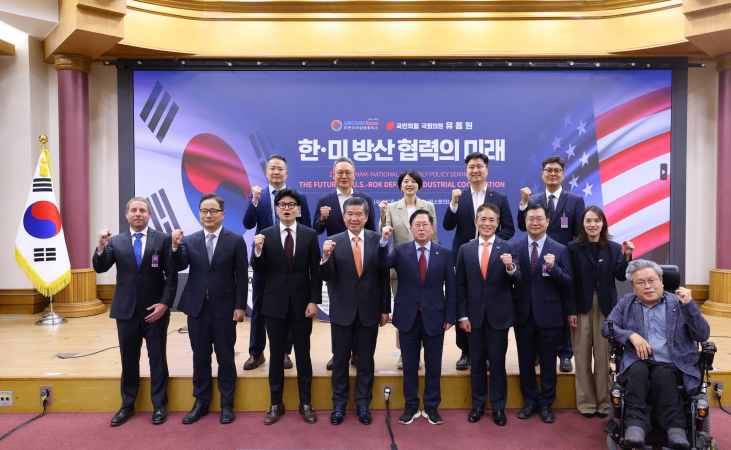
The American Chamber of Commerce in Korea (AMCHAM) made a case for closer
defense manufacturing ties with the United States to the National Assembly on
Wednesday, in what the chamber called its first policy seminar at the
legislature devoted to the subject.
The 2026 AMCHAM -National Assembly
Policy Seminar was held at the National Assembly Members' Office Building in
Yeouido, western Seoul, in partnership with the office of conservative People
Power Party Rep. Yu Yong-weon under the title "The Future of U.S.-ROK
Defense Industrial Cooperation," referring to South Korea by the
initialism for its official name.
The central question put to speakers was
whether cooperation built through individual weapons programs can be extended
into a standing industrial relationship covering development, production,
maintenance and supply chain integration.
Yu, a member of parliament's National
Defense Committee, used his opening remarks to argue for a two-way arrangement.
"Expanding opportunities for Korean
companies in the U.S. defense market, while enabling U.S. companies to draw on
Korea's advanced manufacturing base and technological strengths, would open the
door to far broader cooperation," Yu said. "I am committed to
advancing the policy support needed in the National Assembly to ensure that
defense industrial cooperation becomes another pillar of a stronger Korea-U.S.
alliance."
AMCHAM Chairman and CEO James Kim framed
the sector as a competitiveness issue as much as a security one.
"As Korea takes on an increasingly
prominent role in the global defense industry, we have an opportunity to move
this partnership to the next level through greater co-development,
co-production, co-sustainment and a deeper integration of our defense industrial
bases," said Kim. "Realizing that this opportunity requires not only
strong industry leaderships but also policy and institutional frameworks that
support long-term investment, strengthen the resilience of supply chains,
enable innovation and provide greater predictability across procurement
cycles."
"It seems that the days are already
over when diplomacy for us meant simply hiding behind the United States and
when doing so was economically advantageous," said independent Rep. Han
Dong-hoon, highlighting the changing environment in both U.S. domestic politics
and geopolitics. "I do not believe this is an issue unique to the Donald
Trump administration. I think the trend will continue even under subsequent
administrations."
"Given this situation, I believe
our defense industry, one of our strengths, needs to show greater imagination
and further strengthen technological cooperation with the United States,"
said Han.
The industry sessions were more
specific. Kim Young-je, president of GE Aerospace Korea, said the country's
aerospace sector had reached an inflection point and pointed to where further
capability-building would be needed, such as advanced engine development and
propulsion systems.
Lee Won-ik, country executive for Korea
at Lockheed Martin, ran through what the company describes as a partnership of
more than 70 years, covering work with Korean industry on the KF-16, T-50,
KF-21, UH-60 and the KDX-III Aegis destroyer.
"Going forward, we will continue
leveraging Korea's exceptional industrial capabilities and Lockheed Martin's
technological leadership to create new opportunities for the defense sectors of
both nations," Lee said.
Dylan Landis, the business development
principal at Sikorsky, a Lockheed Martin company, presented the next-generation
X2 helicopter as a candidate for co-development and production with Korean
partners, with an eye on export markets.
"A defense system's value is far
more than the operational capabilities delivered at program onset," said
Landis. "This means Korea needs the ability to maintain, repair, upgrade
and eventually modernize the system it operates. A strong Korean maintenance ecosystem
provides operational readiness for the Korean military while simultaneously
creating highly skilled jobs and industrial capacity."
Source: https://www.koreajoongangdaily.com/business/amcham-makes-case-for-stronger-defense-industrial-ties-with-us-in-assembly-seminar/12866735