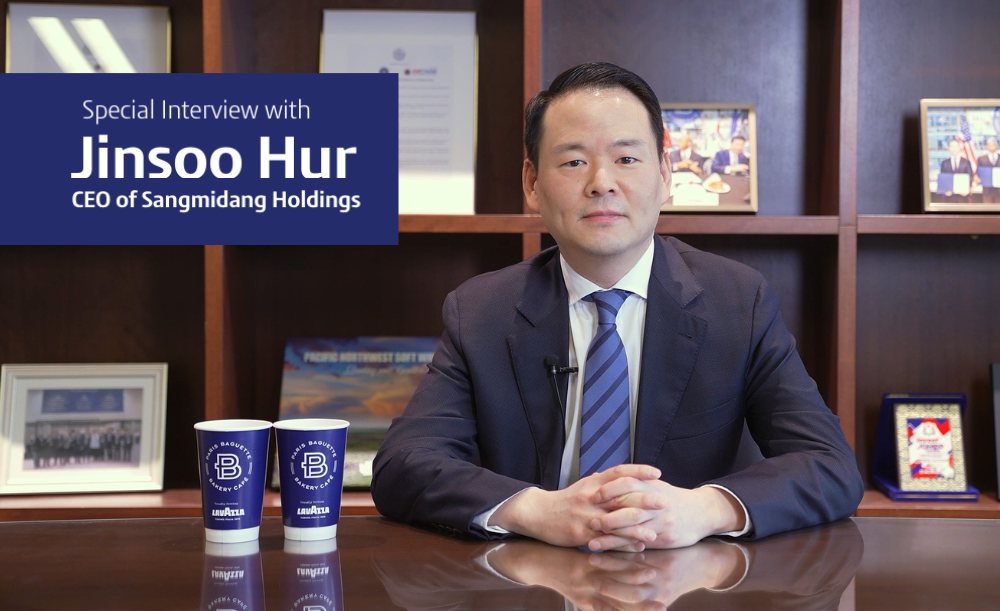
Special Interview with Jinsoo Hur, CEO of Sangmidang Holdings
(Featured in 2026 3Q AMCHAM Journal)
How has your perspective on leadership evolved as Sangmidang Holdings
has grown into a more global organization?
In the past, leadership was centered on execution-oriented decision-making in the domestic
market and the development of high-quality products. As Sangmidang Holdings has
evolved into a global organization, however, our approach to leadership has also evolved to
emphasize cultural diversity and the establishment of global standards.
Today, employees from diverse
cultural backgrounds work
together across multiple
countries, including the United
States, China, and France. In this
environment, leadership must be
more multifaceted. A leader’s role
now extends beyond simply giving
direction. It requires the ability
to respect the unique cultural characteristics of each region while consistently instilling
Sangmidang Holdings’ core value of quality management across all of our global operations.
We believe in empowering local management teams by delegating authority with
confidence, while maintaining an uncompromising commitment to food safety and quality.
This is the leadership principle we strive to uphold.
Paris Baguette has expanded far beyond Korea and now operates across the
U.S., Southeast Asia, Europe, and other markets. What do you think makes
Korean bakery and café brands resonate with global consumers today?
I believe global consumers are drawn to Paris
Baguette because of its “One-stop Bakery”
model and its exceptional quality and product
variety. Traditional bakeries in the United
States and Europe often specialize in specific
categories, such as artisan bread, desserts,
sandwiches, or beverages. By contrast, Paris
Baguette offers a differentiated experience
by allowing customers to enjoy high-quality pastries, cakes, freshly made sandwiches, and
premium coffee all in one place.
Combined with Korea’s meticulous craftsmanship and strong capabilities in developing
trend-driven products, Paris Baguette has become more than simply a place to buy bread. It
has established itself as a multifaceted lifestyle destination.
Many Korean companies aspire to become truly global consumer brands,
yet only a handful have succeeded in building lasting connections with
consumers across international markets. What do you believe distinguishes
companies that thrive globally from those that struggle to gain long-term
traction overseas?
The defining difference between companies that achieve long-term success overseas and
those that eventually withdraw from international markets lies in their ability to strike the
right balance between thorough localization and core capabilities. Companies are likely
to fail if they simply transplant the business model that succeeded in Korea into overseas
markets, or conversely, if they focus so heavily on adapting to local markets that they lose
their distinctive brand identity.
Sustainable global brands maintain an unwavering commitment to the non-negotiable
foundations of their business – including their core products, proprietary manufacturing
technologies, and unique brand identity – while taking a thoroughly localized approach
in areas that build upon those foundations, such as marketing, store development, and
localized menu offerings, by relying on local experts and responding to local consumer
preferences.
In other words, success ultimately depends on achieving the perfect combination of a global
standard operating system and local flexibility.
As Sangmidang Holdings expands internationally, how do you balance
maintaining a distinct Korean identity while also adapting to local tastes
and consumer preferences in each market?
As I mentioned in my previous answer, our business is built around a “glocalization״ strategy.
We strictly preserve our brand identity, which is rooted in French bakery traditions while
incorporating the refinement and attention to detail that characterize Korean craftsmanship.
Our signature store design, proprietary baking technologies, and core product lineup are
standardized so that customers can experience the same level of quality anywhere in the world.
At the same time, our approach becomes much
more localized when it comes to individual menu
offerings. For example, in the United States, where
celebration and party culture is well established,
we have expanded our lineup of large-sized
celebration cakes. In Southeast Asian markets
with significant Muslim populations, we develop
halal-certified products and introduce menu items
that incorporate local ingredients. In other words,
we preserve the core DNA of our brand while
respecting the cultural context and eating habits
of customers in each market.
Likewise, Samlip, the leading brand in Korea’s
packaged bread market, continues to maintain its core identity in overseas markets by
building on decades of accumulated manufacturing expertise, rigorous quality management
capabilities, and product development know-how that has been proven in the Korean
market. At the same time, because food culture and consumer preferences vary from
country to country, we carefully tailor elements such as flavor profiles, texture, sweetness,
packaging formats, and distribution methods to meet the needs of local consumers.
In addition, as global interest in K-food continues to grow, so too has demand for the unique
experiences that only Korean brands can offer. Rather than localizing Korean characteristics
to the point that they lose their distinctiveness, we focus on reinterpreting them in ways that
make them approachable and enjoyable for local consumers.
The United States has become one of SPC’s most important growth
markets, including major investments in manufacturing and retail
expansion. What have been the biggest lessons from competing in the U.S.
consumer market?
The U.S. market is, in many ways, more like a vast multinational market than a single country,
with each state having its own legal framework, tax system, and logistics environment. The
biggest lesson we have learned is the importance of building standardized operating systems
and establishing a resilient supply chain. As we have refined our operating systems to align
with the varying franchise regulations and labor environments across different states, we
have accumulated significant expertise and practical know-how.
We have also learned that focusing solely on expanding the number of stores inevitably
exposes limitations in logistics and quality management in a market as large and complex
as the United States. To support sustainable franchise expansion, local manufacturing
capabilities and an efficient logistics network must be established first.
Korea has become globally recognized for its leadership in entertainment,
technology, and culture, while Korean food brands are also gaining
growing international influence. From your perspective, what responsibility
or opportunity comes with representing Korea on the global stage as a
Korean consumer brand? How is SPC evolving to meet changing consumer
expectations?
Alongside K-pop, K-dramas, and K-beauty, K-food is enjoying one of the most favorable global
market environments in its history. Sangmidang Holdings is well positioned to capitalize on
this momentum. The numbers speak for themselves – in Entrepreneur magazine’s 2026
Franchise 500 rankings, Paris Baguette was ranked 29th overall and No. 1 in the Bakery Café
category. This represents a 13-place jump from its 42nd-place ranking the previous year,
reflecting both its strong growth trajectory and operational stability in the North American
market.
At the same time, today’s global consumers – particularly younger generations – look
beyond product quality. They also pay close attention to the companies behind the products.
In an era where ESG disclosure has become standard practice, issues such as recurring
industrial accidents or labor-related controversies can quickly reach consumers around the
world through digital channels.
In response, Sangmidang Holdings has established comprehensive compliance and ethical
management systems across its affiliates. In addition, all of our affiliates have adopted Fair Trade Compliance Programs as part of our ongoing efforts to meet the increasingly high
expectations of global consumers.
We have now moved beyond the stage of making experimental overseas expansions on the
back of the Korean Wave. Instead, Sangmidang Holdings is entering a phase of qualitative
growth, carefully selecting markets while placing greater emphasis on profitability and long
term sustainability. This reflects our belief that sustaining a strong brand image is now just as
important as expanding the number of stores.
Sangmidang Holdings has spoken publicly about the importance of
restoring consumer trust and strengthening internal standards. From your
perspective, what does rebuilding trust look like in practice?
The “rebuilding of trust” that we refer to does not simply mean improving our image or
carrying out public relations activities. I believe it is a process of genuinely raising standards
across all areas of management so that consumers can choose our products and services
with confidence, and of continuously demonstrating the results of those efforts.
More specifically, first, it means operating stricter internal management systems
related to quality, safety, and compliance, and transparently disclosing the causes and
corrective measures when issues arise. Second, it means going beyond simply receiving
consumer feedback and building a system that meaningfully reflects that feedback in
product development, quality improvement, and service operations. I believe the voice
of the customer must be connected to management decision-making. Third, it means
strengthening training and internal controls so that all employees share the same standards
and sense of responsibility, while establishing an organizational culture that prioritizes
sustainability and ethics over short-term performance.
Ultimately, trust is a value that is judged not by words, but by actions and results.
Sangmidang Holdings is focused on rebuilding trust by steadily accumulating changes and
improvements that consumers can truly experience.
What kind of company does Sangmidang Holdings aspire to become for
future generations of employees?
Sangmidang Holdings traces its origins to Sangmidang (賞美堂), a small bakery established in
Ongjin in 1945. At the heart of our company is our founder’s philosophy: “You may produce
millions of loaves of bread, but customers will judge you by a single loaf.״
We hope that future generations of employees will remember Sangmidang Holdings
not simply as a large corporation with strong sales, but as an exceptional workplace that
remained true to this fundamental spirit – one that was uncompromising in upholding the
basics, while genuinely empowering each individual to exercise autonomy and grow on the
global stage.
Looking ahead, how do you envision Sangmidang Holdings evolving as a
global brand over the next decade?
Over the next decade, Sangmidang Holdings will evolve beyond being a “Korean-style
bakery״ into a global F&B company and an F&B technology and infrastructure group that
helps shape food culture around the world. Building on our transition to a holding company
structure, and supported by significant investments across North America and Asia, our
evolution will focus on three key strategic priorities.
First, we will complete a global supply chain built around regional production hubs. In the
past, our overseas expansion largely relied on exporting products manufactured in Korea or
operating small-scale local production facilities. Going forward, we will establish fully localized
production systems in key markets. Anchored by our large-scale bakery manufacturing facility
in Texas and our halal-certified production plant in Johor Bahru, Malaysia, we aim to strengthen
both cost competitiveness and supply chain resilience. These investments will provide the
foundation for the stable operation of 12,000 Paris Baguette stores worldwide by 2030.
Second, we will lead the bio-food sector through R&D based on proprietary Korean yeast
strains, showcasing differentiated K-bakery technologies to the global market.
Finally, Paris Baguette will expand beyond a single-brand strategy to build a broader global
F&B ecosystem. Just as we have secured exclusive rights to operate global brands such as
Shake Shack and Chipotle in Korea, as well as in markets including Singapore, we also intend
to strengthen our role as a platform for introducing and establishing promising global brands
across Asia.
Read the full article in the 3Q AMCHAM Journal.