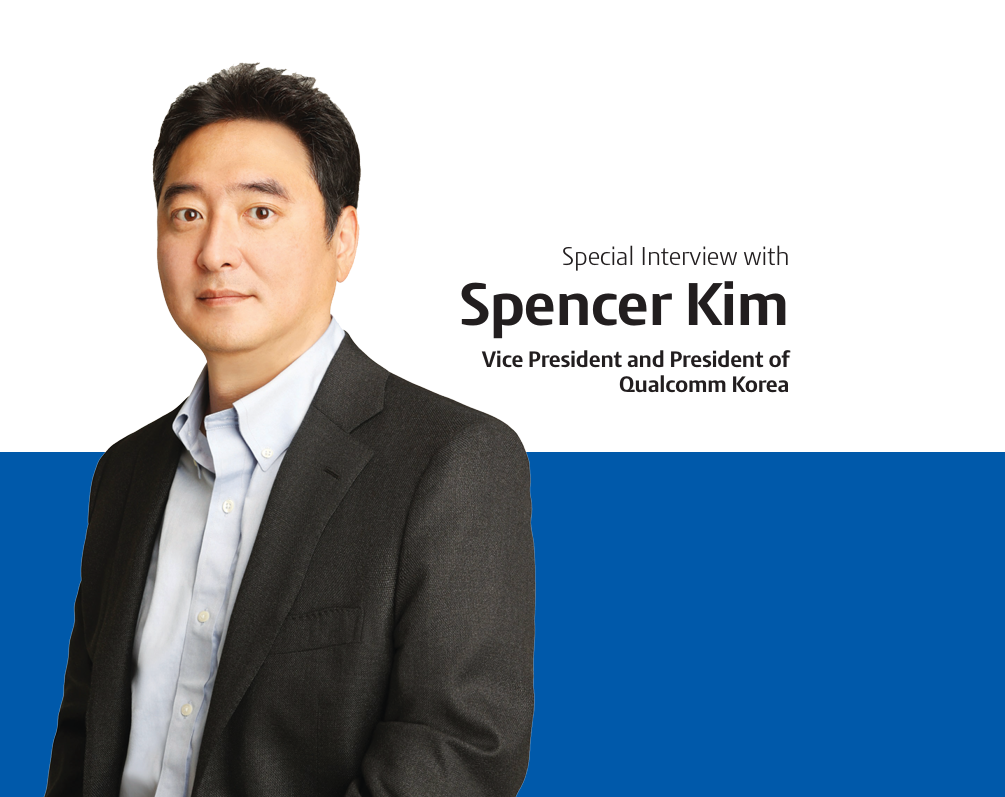
Special Interview with Spencer Kim Vice
President and President of Qualcomm Korea
(Featured in 2026 2Q AMCHAM Journal)
You were recently appointed President of
Qualcomm Korea after more than two decades at the company. How has your career
journey shaped your priorities in this new leadership role?
I joined the company when mobile technology
was still at an early stage, and over the years I have seen Qualcomm evolve far
beyond mobile – into AI, automotive, compute, XR, Industrial embedded IoT and
intelligent connectivity. Experiencing that transformation firsthand has given
me a long-term perspective on what it takes to build sustainable leadership in
a fast-changing industry.
Throughout my career, I’ve learned that
long-term success requires balancing strong execution today with a clear vision
for tomorrow. That perspective has shaped how I approach my new role as
President of Qualcomm Korea.
I’m also grateful for the trust and
leadership of SVP & President of APAC O.H. Kwon, whose guidance and
emphasis on long-term thinking have had a meaningful influence on my own
leadership approach.
One of my key priorities in this role is
staying deeply connected to our customers and partners in Korea. Having worked
closely with them for many years, I’ve learned that enduring partnerships are
built on trust, transparency, and consistency over time.
Another major priority is empowering our
people. I strongly believe that innovation happens fastest when teams have
clear direction, a sense of ownership, and the confidence to make decisions. As
President, my role is to remove obstacles and create an environment where teams
can perform at their best.
My career journey has also reinforced the
importance of aligning Korea’s strengths with Qualcomm’s global strategy. Korea
plays a critical role in shaping the future of semiconductors, devices, and AI,
and I see a strong opportunity for Qualcomm Korea to continue serving as a
strategic contributor to the global organization.
Finally, having experienced multiple
industry cycles, I place a strong emphasis on resilience and adaptability.
Technology and markets will continue to evolve rapidly, and leadership today is
about preparing the organization not just to respond to change, but to lead
through it.
Overall, my priorities are shaped by my
experience at Qualcomm – focused on people, partnerships, and long-term impact
– to ensure that Qualcomm Korea continues to grow, innovate, and lead in the
years ahead.
Qualcomm has been broadening its focus
beyond mobile into automotive software-defined vehicle platforms, industrial
edge AI silicon, and physical AI robotics. Can you tell us about this
evolution, and how this diversification strategy plays out in Korea?
Qualcomm began as a mobile technology
pioneer, but today our vision extends far beyond smartphones. We see the future
of computing as intelligent, connected systems powered by advanced on-device
AI. As a result, Snapdragon now powers a wide range of categories including AI
PCs, XR devices, software-defined vehicles, industrial IoT, edge AI platforms,
and robotics. The common foundation across all of these areas is our ability to
deliver high performance, power-efficient computing with advanced connectivity and
integrated AI. This evolution reinforces our broader vision of extending mobile
innovation into a unified platform for intelligent computing across industries.
Korea is a great example of how our
diversification into computers works. The Snapdragon X series with multiple PC
makers brings products to the Korean market and is competing to lead. A major
driver is ecosystem readiness, with thousands of compatible apps and over a
thousand native apps, making these PCs frictionless for users. We are already
looking toward second generation Snapdragon X platforms to raise the bar on
performance, battery life, on-device AI and expanding into more form factors as
the market broadens this year.
In the automotive sector, our expansion
responds to the industry shift toward software defined vehicles. With
centralized AI-driven architectures becoming the standard, we are addressing
this through the Snapdragon Digital Chassis, an end-to-end platform spanning
connectivity, digital cockpit, ADAS, and cloud services. In Korea, this
strategy closely aligns with Automotive manufacturers and strategic partner’s
priorities around SDV, central compute and long-term platform collaboration,
supported by a strong ecosystem across automotive, electronics and
semiconductors.
Furthermore, our expansion into IoT is
transforming industries through physical AI. We are also seeing strong momentum
in edge AI and robotics across Korea. We are working with Samsung Electronics
to reinforce on-device AI features including object detection and liquid
detection on Samsung premium robot vacuum cleaner. Companies such as Hyundai
Motor Group Robotics Lab are developing robotics platforms powered by
Dragonwing IQ series for various types of service robots, while SK Intellix is
exploring new AI-fueled wellness solutions delivering vital sign check and
mobile air purification via smart AI autonomous navigation. We are also
collaborating with LG Electronics on home robots while providing industrial IoT
solutions for manufacturing, logistics, and retail. Working with local
partners, we aim to broaden the reach of these technologies across diverse
businesses.
As the industry begins laying the
groundwork for 6G, while on-device AI is already transforming today’s devices,
how does Qualcomm balance long-term technology leadership with near-term
commercial execution in edge AI?
Long term technology leadership and near
term commercial execution are not treated as trade offs, they are mutually
reinforcing. Our innovations that power edge AI today are laying the foundation
for the age of AI.
6G represents a generational opportunity –
AI will become the foundation of every experience. Intelligence will be
distributed across devices, the edge, and the cloud, enabling higher levels of
efficiency and performance, new agentic consumer and enterprise devices, and
new classes of AI-enabled services. It will be a completely new end to end
system architecture with AI embedded natively across the network, unifying
connectivity, distributed computing, and built in sensing into a single AI
driven platform. As part of laying this groundwork, at MWC Barcelona 2026, we
announced a new strategic coalition with leading industry partners to invest,
innovate, and enable a shared vision for commercial deployment beginning around
2029.
At the same time, edge AI is already
driving the shift to agentic AI experiences. Devices are becoming intelligent
agents that can see, hear, decide, and act in real time. As an edge AI leader,
we deliver real-time performance, personalization, and efficiency at scale
across device categories and industrial systems powered by our platforms.
The ability to lead in foundational
technology while delivering at commercial scale is what has defined our
leadership in every wireless generation.
Qualcomm has historically played a
significant role in global wireless standardization and next-generation
connectivity. How does Qualcomm Korea engage in standards development and
regulatory discussions, and how important is Korea’s voice in shaping emerging
technologies?
Qualcomm has long played a central role in
global wireless standardization, and Korea is one of the most important markets
where this leadership is actively exercised. Qualcomm Korea works closely with
Korean operators, industry partners, and policymakers to ensure that Korea’s
advanced network environment and technical expertise are reflected in global
standards discussions.
As the industry begins shaping the path
toward 6G, Korea’s voice is particularly influential. Korean operators and
technology leaders are not only early adopters of new technologies, but active
contributors to defining future network architectures. Through close
collaboration with partners such as Samsung Electronics, SK Telecom, KT, LG
Electronics, and LG Uplus, Qualcomm is helping drive the transition toward AI
native networks, where connectivity, computing, and intelligence are deeply
integrated.
This engagement allows Korea to serve as a
reference market for next generation wireless technologies, while enabling
Qualcomm to translate local innovation into globally scalable platforms.
Korea is one of the world’s most
advanced mobile and electronics ecosystems. How does Qualcomm Korea tailor its
strategy compared to other regional markets? Are there areas where Korea plays
a unique strategic role within Qualcomm’s global roadmap?
Korea holds a uniquely strategic position
in our global roadmap, integrating world class leadership in smartphones,
semiconductors, automotive, and consumer electronics within a single market.
Our approach here is centered on collaborative development rather than simple
market deployment.
A prime example is our partnership with
Samsung Electronics, a global leader in mobile innovation. Qualcomm works with
Samsung as a deeply strategic partner. Our collaboration goes well beyond a
standard supplier relationship – from platform definition to premium
customization, including the Snapdragon 8 series “For Galaxy” products that are
specifically optimized for Samsung’s flagship devices. Through this
partnership, Qualcomm and Samsung continue to set the pace for the Android
ecosystem, bringing the most advanced performance, on-device AI, camera,
display and connectivity experiences to market first. As a result, Korea serves
not only as a key market, but as a global reference point for Android
innovation.
Beyond mobile, Korea stands as a strategic
hub shaping the future of mobility, uniquely uniting worldclass mobile,
consumer electronics, and automotive ecosystems, where Qualcomm Korea drives
deep co-development with OEMs and Tier 1 partners to advance software defined
vehicle platforms across centralized compute, connectivity, and SDV
architectures.
As Korea works toward its ambition of
becoming one of the world’s leading AI economies, where do you see Qualcomm
playing the most meaningful role?
As Korea advances toward becoming a leading
AI-driven economy, we believe Qualcomm can play a pivotal role across the full
spectrum of hybrid AI – where edge AI work seamlessly together with the cloud.
Centered around smartphones, which remain
the most widely used personal devices, we are helping enable always-connected,
instantly responsive AI experiences across personal AI form factors, including
emerging devices such as smart glasses.
At the same time, by providing technologies
that make AI faster, more reliable, and more power-efficient across homes and
industries – from consumer electronics and robotics to manufacturing and smart
cities – we see Qualcomm’s most important role as helping Korea’s AI ecosystem
deliver real, tangible value in the field.
We are continuously discovering and
engaging SMEs and startups that are developing innovative AI solutions and
services. Through our global program, Qualcomm Partner Network, we help these
SME and startup strengthen their presence in the global market to find business
opportunities. As part of our commitment to advancing Korea’s AI ecosystem, we
actively bring together customers and partners to collaborate – supporting
rapid development and accelerating the journey from innovation to
commercialization. Building on last year’s efforts, Qualcomm is once again
participating in Everyone’s Challenge AX program led by Ministry of SMEs and
Startups (MSS) this year. Through this initiative, we aim to identify and
nurture next generation AI solutions – including robotics platforms, AI
glasses, and AI on premise appliances – in close collaboration with startups
and Qualcomm partners.
In addition, our acquisitions of Arduino,
an open hardware and software platform company, and Edge Impulse, a leading
MLOps solution provider, have significantly accelerated access to Qualcomm’s
technologies. Through Edge Impulse, SME and startups can easily and efficiently
manage the entire AI development pipeline – from data labeling to AI model
training and optimization. At the same time, Arduino platform powered by
Qualcomm Dragonwing enables rapid prototyping, allowing developers to move
quickly from concept to working solutions. Together, these platforms are
helping startups innovate faster and bring AI ideas into real world
applications with greater ease.
A key element of Qualcomm’s growth
strategy is powerful collaboration. Can you tell us about some of Qualcomm
Korea’s major partnerships? How do you approach building partnerships that both
reflect Qualcomm’s global priorities and leverage Korea’s unique strengths?
Collaboration is the core engine of
Qualcomm’s growth, and Qualcomm Korea’s partnership strategy is built around
enabling on device AI across mobile, AI PCs, XR, and the broader edge
ecosystem. A central pillar of this approach is our deep collaboration with
Samsung, a global technology leader that plays a critical role in advancing the
Android ecosystem and premium device experiences worldwide. By working closely
together, we help accelerate innovation in on device AI while aligning closely
with Qualcomm’s global technology and platform priorities.
Another key focus is our partnership with
Korean operators, centered on enabling intelligent connectivity across devices,
the edge, and the network. As on device AI becomes more capable, networks must
evolve beyond basic connectivity to support distributed intelligence, low
latency, and seamless interaction between devices and cloud services. Working
closely with Korean operators, we explore how next generation networks can
enable AI driven services, advanced edge computing, and new enterprise and
consumer use cases, with Korea serving as an ideal testbed thanks to its
advanced infrastructure and fast innovation cycles.
Our partnerships in Korea are also closely
aligned with Qualcomm’s long term growth roadmap, particularly in automotive
and IoT. In automotive, we collaborate with strategic partners to co develop
software defined vehicle and ADAS platforms that can scale globally. In IoT, we
work with partners such as Samsung’s Digital Appliances division, startups, and
ecosystem players to advance AI enabled devices and new services. By combining
Qualcomm’s global platform strategy with Korea’s engineering depth and speed of
innovation, Qualcomm Korea helps shape technologies and business models that
can be adopted worldwide.
Qualcomm has heavily invested in
developer ecosystems through hackathons, startup programs, and edge AI
initiatives. Can you tell us about the philosophy behind these initiatives? How
does nurturing startups and developers strengthen Qualcomm’s platform over the
long term?
Our philosophy is simple: a platform grows
stronger through its ecosystem. Through hackathons, university programs, and
developer initiatives, we aim to lower the barriers to innovation so more
people can build on Qualcomm’s technologies.
The role of developers is evolving with
AI-assisted or vibe coding, where AI becomes part of the development process.
Still, human developers remain essential – they define problems, guide AI, and
turn ideas into real-world solutions. That is why investing in people and
communities continues to matter.
This is reflected in our recent ecosystem
investments. Arduino provides one of the easiest entry points for students and
startups to learn and build edge and AI solutions, while Edge Impulse makes it
simple to apply AI to real-world data such as audio, images, and time-series
signals. We believe both platforms will significantly support AI education and
startup innovation.
As developers and startups build on
Qualcomm platforms, they generate real-world use cases and feedback that help
us continuously improve our technology. Over time, this virtuous cycle is what
turns advanced hardware into a widely adopted, long-term platform.
The global semiconductor industry is
shaped by geopolitics, supply-chain shifts, and AI acceleration. In a period of
rapid change, how is Qualcomm positioning itself to remain resilient and agile
in Korea?
Change is constant in the semiconductor
industry, and Qualcomm is positioned to remain agile through disruption. A
diversification strategy, built on a broad technology portfolio, enables the
company to drive transformation across industries while moving quickly and
executing with precision. By building and cultivating global technology
ecosystems, Qualcomm gains early insight into market shifts, enables innovation
at scale, and strengthens its ability to not only respond to change, but help
define what comes next.
In response to geopolitical shifts, supply
chain realignment, and rapid AI momentum, Qualcomm is proactively reinforcing
platform resilience while staying highly responsive to regional needs.
By combining global platform consistency
with deep local partnerships in Korea, Qualcomm remains both resilient and
agile in a rapidly changing semiconductor landscape.
Korea has been positioning itself as an
Asia-Pacific hub for multinational headquarters and advanced technology
investment. From Qualcomm’s perspective, what strengths make Korea attractive
as a regional base, and what areas of collaboration between industry and
government could further enhance its competitiveness?
Korea stands out as one of the most
attractive regional bases for advanced technology investment due to its unique
combination of innovation, infrastructure, and ecosystem strength. It is home
to globally leading companies across semiconductors, consumer electronics,
automotive, and telecommunications, supported by a tech-forward consumer base.
This passionate culture creates an environment where new technologies can be
rapidly developed, tested, and scaled to global markets. For Qualcomm, Korea is
a strategic hub where global innovation is shaped through deep collaboration
with partners like Samsung, LG, and Hyundai Motor Group. Innovation here sets
expectations everywhere because what we achieve together in Korea has a direct
global impact.
The leadership of O.H. Kwon has
consistently been viewed as a cornerstone of its Asia-Pacific strategy. His
long-standing engagement with industry leaders and policymakers contributes to
positioning Korea as Asia-Pacific headquarters for advanced technologies,
particularly in Edge AI, connectivity, next generation mobile and computing.
One example of the commitment is Qualcomm AI Program for Innovators 2025 APAC
Demo Day which was held in Seoul. The event brought together startups from
Japan, Singapore and Korea showcasing Edge AI solutions by leveraging
Snapdragon platforms and Qualcomm Dragonwing, and reinforcing Korea’s role as a
regional hub for innovation and cross-border collaboration.
Partnership with AMCHAM Korea also plays an
important role in this journey. Through close collaboration with AMCHAM,
Qualcomm Korea has been able to actively engage with policymakers, industry
leaders, and the broader business community to highlight how U.S. companies
contribute to Korea’s technology ecosystem and economic growth. Platforms such
as the AMCHAM Inaugural Ball 2026 demonstrate how these partnerships help bring
industry, government, and global companies together, showcasing real-world
innovation across AI, mobility, and digital services while fostering meaningful
dialogue and new opportunities for collaboration. Under the leadership of James
Kim, AMCHAM continues to serve as a vital bridge connecting ecosystems and
amplifying the role of global companies in shaping Korea’s future.
By aligning around a shared vision of
intelligent computing everywhere, and through sustained collaboration between
industry, government, and organizations like AMCHAM, Korea is well positioned
to further solidify its role as a premier technology and innovation hub in the
Asia-Pacific region.
Looking ahead, what is one goal for
Qualcomm that you are especially excited about?
We are at an inflection point where AI is
no longer confined to data centers, but is becoming distributed – running on
devices, at the edge, and across intelligent networks. Qualcomm is uniquely
positioned to enable that shift because of our leadership in efficient compute,
connectivity, and system-level integration.
What excites me most is turning this
architectural advantage into real-world scale. This means making AI pervasive
and practical – powering smartphones, PCs, Automotives, industrial &
embedded IoT, and next-generation AI agents, all while maintaining high
performance, low power, and security.
A key part of this journey is the evolution
toward AI-native networks and 6G. Beyond faster connectivity, 6G represents a
platform where connectivity, compute, and sensing are deeply integrated,
enabling entirely new classes of applications and services.
At the same time, Qualcomm’s expansion into
data center and cloud-to-edge AI including robotics creates a powerful
continuum – where workloads can move seamlessly across devices, edge
infrastructure, and the cloud based on latency, cost, and efficiency requirements.
What makes this goal especially compelling
is the ecosystem dimension. Qualcomm doesn’t innovate in isolation. Our success
comes from working closely with partners across industries to build platforms,
standards, and solutions that scale globally.
Ultimately, the goal is not just to
participate in the AI transformation, but to shape it – by making intelligent
computing more accessible, more efficient, and more impactful for businesses,
developers, and consumers worldwide.
That
opportunity – to help define the next era of computing at global scale – is
what excites me most about Qualcomm’s future.
###
Spencer (Sang
Pyo) Kim joined Qualcomm in 2004 and has played a pivotal role in leading the
company’s business operations in Korea. As Vice President and President of
Qualcomm Korea, Spencer leads Qualcomm’s overall business in Korea. Under his
leadership, Qualcomm Korea has continued to strengthen its leadership position
not only in the mobile ecosystem, but also across diversified and emerging
business segments aligned with Korea’s rapidly evolving technology landscape,
including on-device AI, AI native platforms, edge computing, automotive
platforms, and next generation wireless technologies. By tightly integrating
engineering execution with business strategy, he drives new business creation
and end to end commercialization of Qualcomm technologies across a broad range
of applications, including smartphones, PCs and tablets, wearables, XR,
robotics as well as automotive solutions.