BKL
and AMCHAM map Korea legal shifts, guide global corporations' responses
By Yoo Byoung-hoon, ChosunBiz - Bae, Kim
& Lee (BKL), a limited liability law firm, held a seminar on corporate
response strategies to recent changes in the legal landscape, including
attorney–client privilege (ACP), the Korea-style discovery system, and
constitutional complaint against court judgments.
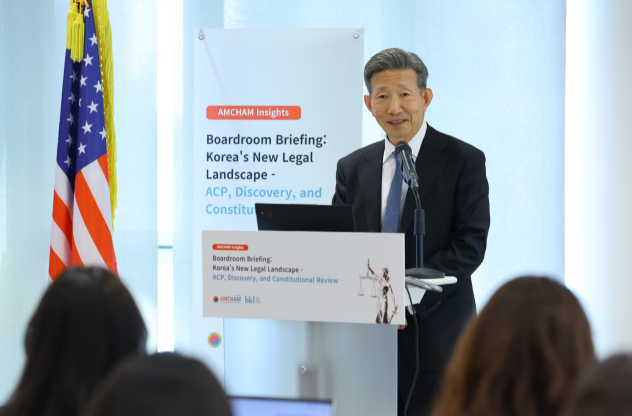
BKL said it hosted an "AMCHAM
Insight" seminar titled "The new map of Korea's legal
environment" with the American Chamber of Commerce in Korea (AMCHAM) at
its Jongno-gu, Seoul, headquarters on the 12th. The seminar was organized to share
legal and regulatory changes and practical response measures with AMCHAM member
companies and domestic and overseas corporations and institutions.
In a welcome address, BKL managing
partner Lee Jun-gi said, "Recent changes in Korea's legal and regulatory
environment are demanding new response standards from global corporations and
in-house legal teams," adding, "BKL will stay close to the real
issues corporations face on the ground and provide more practical and
actionable response strategies and insights."
James Kim, AMCHAM chairman and CEO,
said, "Korea's legal and regulatory environment is undergoing important
changes across corporations' compliance, internal investigations, and risk
management," adding, "Because regulatory clarity and predictability
are key factors that determine investment decisions and long-term corporate
trust, it is important to support corporations so they can respond effectively
to these changes."
In the first session, Noh Min-ho of
BKL's criminal practice presented Korea's ACP system and response measures for
global corporations. ACP is a system that protects certain legal advice
communications between attorneys and clients under specified conditions.
Explaining the significance of the amended Attorney‑at‑Law Act, which recently
codified ACP, and related Supreme Court rulings, Noh said, "Korea's ACP
system is at a turning point, taking a step closer to the global
standard." Noh proposed practical measures such as a segregation and
management framework for legal-advice communications, server and folder
structures that allow ACP protection, and the refinement of day-to-day
communication protocols.
The second session was led by Son
Seung-ho of BKL's antitrust practice. Son explained the Korea-style discovery
system introduced in the Win-Win Cooperation Act, including expert
fact-finding, party examination, evidence preservation orders, and orders to
submit materials collected in administrative investigations; addressed
differences from U.S. discovery; and discussed how proposed amendments to the
Civil Procedure Act could affect corporations' dispute responses. Son said,
"As facts are determined more quickly at the early stages of disputes,
faster decision-making based on relevant information will be possible in
mediation, settlement, and judgments."
In the final session, Kim Kyung-mok of
BKL's regulatory practice, who previously served as senior constitutional
researcher and Director General researcher at the Constitutional Court,
presented the constitutional complaint against court judgments procedure and
practical considerations. A constitutional complaint against a court judgment
is a procedure for seeking a ruling from the Constitutional Court on the
grounds that a court's judgment violated fundamental rights. Kim explained
grounds for dismissal at the preliminary review stage, the requirement of
subsidiarity, and how to specifically state grounds for infringement of
fundamental rights. Kim said, "From the stage of drafting the
constitutional complaint, it is important to specifically identify the
infringement of fundamental rights and meticulously organize the facts."
BKL is establishing response frameworks
for ACP, the Korea-style discovery system, and constitutional complaint against
court judgments. It has formed a constitutional complaint task force (TF), is
refining its internal systems and practical protocols to protect ACP, and is
strengthening its capabilities in electronic information analysis and evidence
management in preparation for the expansion of the Korea-style discovery
system.
Source:https://biz.chosun.com/en/en-society/2026/05/13/I2YG7UFQY5G6TPW7PBZDULH55M/