AMCHAM report highlights regulatory hurdles facing U.S. firms
in Korea
By Lee Gyu-lee, The Korea Times - The American Chamber of
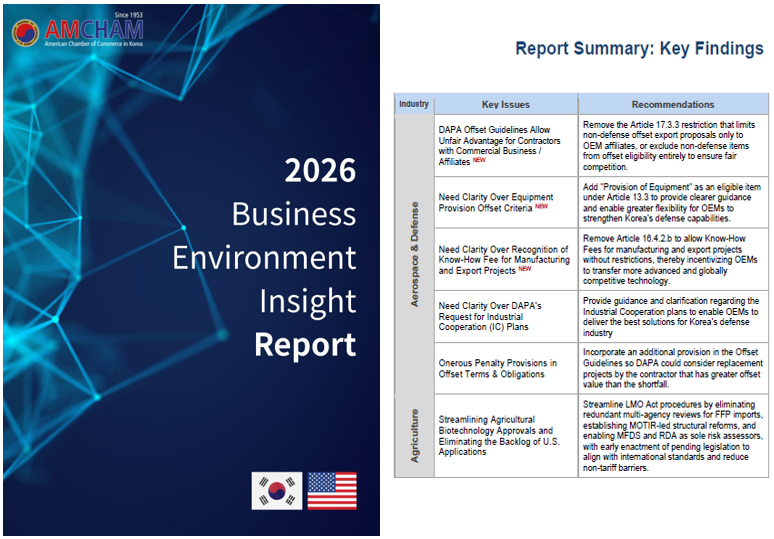
Commerce in Korea (AMCHAM) released on Tuesday its annual 2026 Business
Environment Insight Report outlining key regulatory challenges and policy
recommendations aimed at strengthening Korea’s competitiveness as a regional
headquarters and innovation hub for U.S. companies.
In its report, AMCHAM identified key regulatory challenges
facing U.S. companies in Korea, including issues that may function as nontariff
barriers, AMCHAM Chairman and CEO James Kim said.
The report said complex regulatory structure, policy
inconsistency and misalignment with global standards continue to burden
business activity. Overlapping regulations, frequent policy changes and limited
predictability were also cited as major sources of uncertainty in investment
and operations.
These challenges, the report pointed out, are becoming more
critical in emerging sectors such as artificial intelligence and digital
infrastructure, where policy clarity, cross-border data mobility and reliable
access to energy and infrastructure are seen as essential to innovation and
large-scale investment.
The report comes amid intensifying global competition
across advanced industries, supply chains and artificial intelligence,
emphasizing that regulatory transparency, predictability and alignment with
global standards are increasingly decisive in attracting investment and
supporting sustainable growth.
While Korea remains a stable and highly capable market, Kim
said it must enhance regulatory predictability and global alignment to sustain
competitiveness. He noted an earlier discussion with President Lee Jae Myung,
where they talked about the goal of increasing the number of regional
headquarters in Korea — from about 100 currently to 1,000 — during his term.
Kim said AMCHAM stands ready to work closely with the
Korean government, including the newly established Regulatory Rationalization
Committee, to address unnecessary regulatory gaps and support a more
transparent, predictable and globally aligned business environment.
The 2026 report covers 11 major industries and 75 policy
issues, up from 66 issues identified last year. The sectors include aerospace
and defense, agriculture, automobiles, chemicals, the digital economy, energy
and environment, financial services, labor, medical devices, pharmaceuticals
and taxation.
Financial services, automobiles and chemicals accounted for
the largest number of issues, followed by pharmaceuticals and the digital
economy, indicating where regulatory challenges are most concentrated. The
report also builds on findings from the Office of the United States Trade
Representative and the U.S.-Korea Joint Fact Sheet, highlighting the need to
address nontariff barriers and improve regulatory alignment.
The report also calls for greater labor market flexibility,
stronger legal and regulatory predictability and financial market reforms to
support global capital inflows and reinforce Korea’s position in the regional
and global economy.
AMCHAM said it will continue engaging government
stakeholders and industry leaders to advance policy dialogue and support
implementation of the recommendations.
Source: https://www.koreatimes.co.kr/business/companies/20260429/amcham-report-highlights-regulatory-hurdles-facing-us-firms-in-korea?utm_source=legacy_url&utm_medium=redirect&utm_campaign=article_legacy_id