US DOGE-style ministry
feasible in Korea, AMCHAM chief says
Tough labor
laws still cited as obstacles to attracting multinational firms
By Park
Jae-hyuk, The Korea Times - American Chamber of Commerce in Korea (AMCHAM)
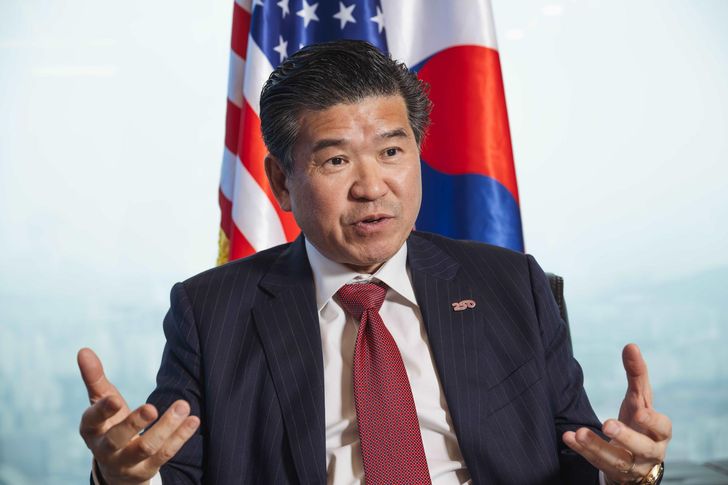
Chairman James Kim supported the idea of the Korean government establishing a
businessperson-led ministry, similar to the now-dissolved Department of
Government Efficiency (DOGE) in the United States.
Calling the
concept one way to advance the chamber’s continuing efforts to encourage
multinational companies to place their Asia-Pacific headquarters in Korea, the
Korean American head of the U.S. business lobby emphasized the need for
regulatory predictability and labor flexibility if Korea is to compete
effectively with Singapore, Hong Kong and Shanghai.
"It's
very feasible, and it's important for Korea," Kim told The Korea Times in
an interview on Feb. 10 when asked whether he intended to suggest that the
government elevate the existing joint committee on regulatory reforms to a
ministry or quasi-ministry similar to DOGE.
Despite the
common belief that Korea’s liberal party tends to tighten regulations when it
comes to power, the chairman remained optimistic about potential deregulatory
measures under President Lee Jae Myung, whom he described as someone who has
consistently shown strong enthusiasm for AMCHAM’s initiatives.
"At the
recent presidential roundtable with foreign business leaders in Korea, I
emphasized the importance of regulatory reform as a critical foundation for
positioning Korea as the premier investment hub in the region," Kim said.
"Following our discussion, Lee promised to create the Regulatory
Rationalization Committee at the presidential office, showing his resolve to
make this a priority during his term."
He added that
AMCHAM stands ready to work closely with Lee and his administration, including
the newly formed committee, to further strengthen Korea’s attractiveness as a
regional hub in Asia.
With the
benchmark KOSPI surpassing the 5,000 mark this year, the business association
also plans to release its first financial services report to promote Korea as a
promising market for a regional financial hub and to support the nation’s
elevation to MSCI Developed Market status, from its current Emerging Market
classification.
"It is
important that we leverage this momentum wisely to further strengthen Korea’s
standing as an attractive and reliable capital market for global
investors," Kim said.
Korea-specific
regulations
The chairman,
however, pointed to labor-related regulations as an area where closer alignment
with global standards could make a meaningful difference.
"The
enactment of the 'yellow envelope act,' together with the increasing intensity
of investigations and audits, is likely to place additional pressure on global
companies in terms of operational costs and regulatory uncertainty," he
said.
The revised
act, formally called the Trade Union and Labor Relations Adjustment Act, aims
to empower subcontracted workers by allowing them to negotiate directly with
their employers’ clients while prohibiting management from seeking compensation
for damages incurred during strikes.
Although
foreign investors have expressed concerns about the new law’s potential impact
on Korea’s business environment and investment appeal, the government has so
far promised only to continue dialogue with business leaders rather than
withdraw the revision.
"Labor
flexibility and talent mobility are increasingly important in a knowledge-based
economy," Kim said. "Companies need the ability to attract global
talent, adjust workforce structures and respond quickly to changing market
conditions."
As possible
ways to ensure labor flexibility while limiting the impact on the job market,
he proposed exemptions for small companies from the regulations or the
designation of specific zones where labor laws are eased.
Freedom 250 initiative
Throughout the
interview, the chairman dismissed concerns about friction between Korea and the
U.S., despite the Donald Trump administration’s tariff threats and the absence
of a U.S. ambassador to Korea. The interview took place before the U.S. Supreme
Court on Friday (local time) ruled against Trump's "reciprocal"
tariffs on Korea and other countries. After that decision, Trump again imposed
a 10 percent tariff, set to take effect Tuesday, and a day later announced he
wants to raise it to 15 percent.
"Given
the depth and durability of the U.S.-Korea economic partnership, I remain
confident that the two sides can find a practical, win-win solution that
delivers benefits for both countries," he said. "We have seen both
governments continue to engage constructively through dialogue and
cooperation."
Building on
that optimism, Kim introduced the chamber’s plans to highlight the depth of the
two countries’ partnership through various events celebrating the U.S.
semiquincentennial.
"This
year also carries symbolic significance as the U.S. approaches its 250th
anniversary through the Freedom 250 initiative," he said. "We're
going to have a lot of super VIPs from the U.S. government. It could be Marco
Rubio."
Source: https://www.koreatimes.co.kr/business/companies/20260223/us-doge-style-ministry-feasible-in-korea-amcham-chief-says