Korea’s
antitrust chief signals tougher rules for digital platforms
By Moon Joon-hyun, The Korea Herald - South
Korea’s antitrust regulator is preparing to intervene more directly in how
digital platforms operate, arguing that unchecked platform power now affects
everyday consumer choice, pricing and trust as much as it does corporate
competition.
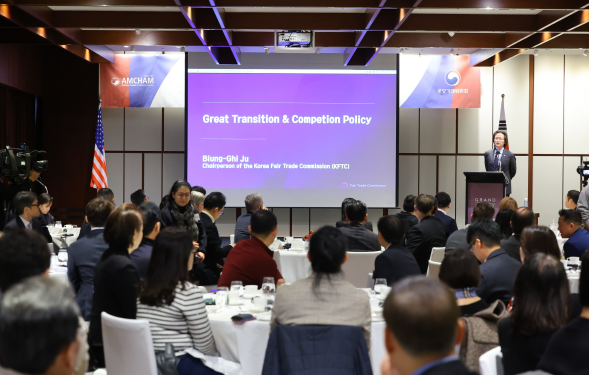
That was the core message from Ju
Biung-ghi, chair of the Korea Fair Trade Commission, who on Monday presented
the agency’s 2026 policy direction at a policy luncheon hosted in Seoul by the
American Chamber of Commerce in Korea.
Ju said Korea’s competition rules must
adapt to an economy increasingly mediated by a small number of digital
platforms. “Online platforms connect multiple sides of the market at once:
consumers, sellers, advertisers and workers,” he said. “Because transaction
costs are so low, a few platforms can quickly dominate entire ecosystems.”
This concentration, Ju argued, changes
how competition issues manifest. Instead of obvious price hikes, harm often
shows up as reduced consumer choice, opaque fees or business practices that
sellers and users cannot realistically refuse. The commission will step up
monitoring of delivery apps and online marketplaces, focusing on pricing
transparency, settlement delays and one-sided contract terms. “Consumers need
clear information across the full transaction cycle,” Ju said, “from ordering
to payment and settlement.”
Ju highlighted the commission’s recent
consent resolution with Google as a model for addressing fast-moving digital
markets. The case involved concerns that Google’s bundling of YouTube video and
music services restricted competition by making rival services harder to
access. “In digital markets, time matters,” Ju said. “A consent resolution
allows us to change conduct faster than years of litigation, which ultimately
benefits consumers.”
He stressed that such agreements are not
a retreat from enforcement. “They are corrective tools,” he said, designed to
restore consumer choice while technology and market behavior continue to
evolve.
Beyond platforms, Ju pointed to
subcontracting practices as a structural issue with consumer consequences.
“Unfair subcontracting leads to delayed payments, cost-cutting and sometimes
safety risks,” he said. The KFTC plans to expand payment guarantee obligations
and promote electronic payment systems to ensure funds reach subcontractors and
workers as intended.
Cartel enforcement remains another
priority. Ju cited a March 2025 decision in which three telecommunications
companies were fined a combined 114 billion won ($77.6 million) for colluding
over mobile number portability, limiting how easily consumers could switch
carriers, according to the KFTC.
Ju also said the commission will seek
higher statutory ceilings for administrative fines and broader civil remedies.
“Compared with the US, the EU and Japan, Korea’s penalties are still low,” he
said.
James Kim, chair of AMCHAM Korea, added
that fair competition and consumer protection are “fundamental to a digital
economy people can trust.”
Source:
https://www.koreaherald.com/article/10636741?ref=naver